
Columbia’s Holocaust Memorial Mentioned in “Peace Cross” Ruling, but Should It Have?

Updated: Aug 20, 2019
Columbia, SC, August 3, 2019. After the Supreme Court ruling in June regarding the “Peace Cross” located in Bladensburg, Maryland, other religious monuments around the country may be safe from separation of Church and State litigation. However, one monument in particular, found in Columbia, South Carolina, was mentioned by Justice Neal Gorsuch in his official opinion on the “Peace Cross” ruling.
“How old must a monument, symbol, or practice be to qualify for this new presumption? It seems 94 years is enough, but what about the Star of David monument erected in South Carolina in 2001 to commemorate victims of the Holocaust…” said Justice Gorsuch.
The “new presumption” he refers to involves the Supreme Court’s opinion that the “Peace Cross” in Maryland does not conflict with the Establishment Clause because the historicity and age of the monument transform it from a religious symbol into a secular landmark honoring the soldiers who gave their lives during World War I.
Justice Alito, who gave the Opinion of the Court, said, “Even if the original purpose of a monument was infused with religion, the passage of time may obscure that sentiment.”
The age of the monument, according to the court, was one of the major factors that determined the outcome of the case. However, Justice Gorsuch argued that this ruling would not protect newer monuments from judgment, like the one he mentioned in Columbia.
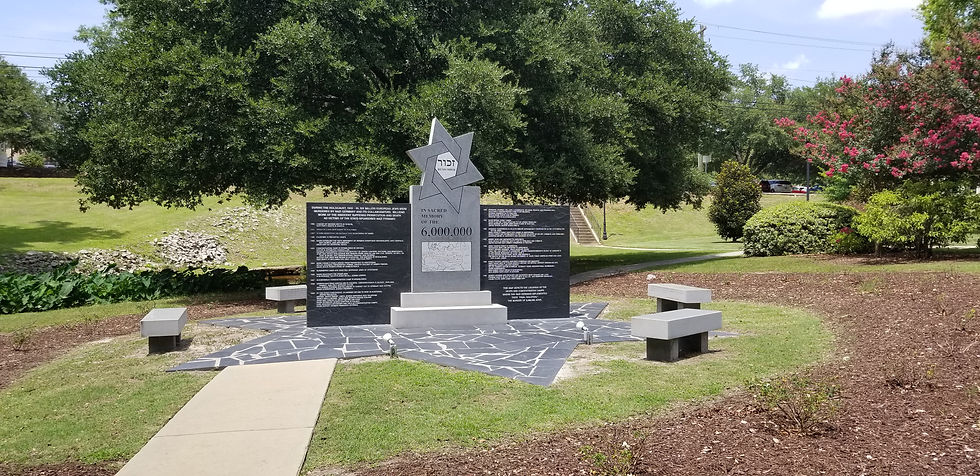
The Holocaust Memorial was commemorated on July 6, 2001, and according to the Columbia Holocaust Education Commission, serves as a memorial to all South Carolina Holocaust survivors. The memorial, which can be found in Memorial Park in downtown Columbia, features the Star of David not only on the monument itself, but also in the shape of the foundation surrounding it. However, according to Dr. Sabine Meyer, who is a Rabbi at the Tree of Life Congregation in Columbia, the Star of David is not necessarily an overt religious symbol.

“The Star of David is a Jewish Symbol, and not exclusively a Jewish religious symbol. Judaism is much more than a religion, it is a culture, a people, an ethnicity,” said Rabbi Meyer.
She went on to say that much like a Holocaust Museum is not a “religious museum”, neither should the Holocaust Memorial be considered a "religious memorial".
The Holocaust Memorial does have one similarity with the Maryland “Peace Cross” that is worth noting, the memorial is displayed and maintained on public property, which was one of the major factors in the “Peace Cross” case.
However, there are some major differences, the Holocaust Memorial is tucked away in a park surrounded by trees and other monuments, including several Vietnam War Memorials. This is a stark contrast to the 40-foot tall Latin Cross at a busy intersection in Maryland. Another difference is that the memorial is dedicated specifically to Jewish victims, which is confirmed by several inscriptions on the monument itself, including the word “Remember” written in Hebrew and English within the Star of David.
According to Dr. Lilly Filler, who is the co-chairmen of the Columbia Holocaust Education Commission, the Holocaust Memorial should not be considered as governmental endorsement of religion.
“I am not sure how anyone could view this as a Separation of Church and State issue, this memorial is not religious in nature, but instead meant to honor those who lost their lives during a horrific time in history,” said Filler.
Based on the results of the Supreme Court ruling, it appears as if many justices would agree. In many of the consenting opinions presented in the court documents, several justices expressed thoughts similar to Filler.
Justice Allito, who gave the official court ruling, touched on this exact issue when he said, “It is also natural and appropriate for a monument commemorating the death of particular individuals to invoke the symbols that signify what death meant for those who are memorialized. Excluding those symbols could make the memorial seem incomplete. This explains why Holocaust memorials invariably feature a Star of David or other symbols of Judaism…”.
Despite the similarities and differences between the two monuments, and that the State of South Carolina co-signed the Amici Curiae in the "Peace Cross" case, there has been no opposition to the Columbia Holocaust Memorial as far as Filler is aware. The protection of this memorial is important to organizations like the Holocaust Education Commission, whose mission is to facilitate the education and remembrance of Holocaust victims.
The monument, which includes a timeline of the events of the Holocaust and a map of labor and concentration camps, serves not only as a memorial but a way to educate. Filler explained this unique approach to memorializing the Holocaust when she spoke about their mission.
“When we commissioned the memorial, we had a three-prong approach, to educate South Carolinians about the Holocaust, to honor the survivors and liberators, and to remember the victims who lost their lives.”
For more information about the Columbia Holocaust Education Commission and the Holocaust Memorial, visit http://columbiaholocausteducation.org/index.php. And for more news and information about the secular community follow @SecularShepherd on Twitter.


Comments